Our study of motions led to one of my favorite topics in all of mathematics: tessellations. I've posted some previous work on this blog, have an old webpage with some good tessellation resources, and found a new source of beautiful Alhambra images to share with students.
As a math topic I just love them. The visual aspect, the geometry, the connections with algebra, the historical context, the art connections with Escher... it's darn near perfect. Working with 2nd - 12th graders they are amazing for rigid motions because you use the motions to make the tiles, then to repeat the tiles in a pattern, then can see the motions in the finished tessellation. It's visual and kinesthetic. There ought to be a song.
Instead, how about some geogebra. For some reason, this time around, I got interested in kites. Which tessellate by side to side rotation and what would a mixed glide reflection/rotation tessellation look like.
The question of which kites tessellate by double rotation boils down to what happens at the joint vertices between the two (possibly) different edges. We can pick the angles so that the kites blossom (tessellate around a point) at the vertices between congruent sides. In this sketch, you set those numbers, then observe the effect on the other angles. What condition is necessary for the angles to work out? Is it sufficient?
This sketch lets you make alterations to that classic 60-120-90-90 kite tiling. The sketch will adjust and give you a chance to both design and watch the effects.
This sketch does a tiling that can be done with any kite. (Pretty good question as to why it works for any kite!) Two of the congruent sides rotate to themselves around a midpoint, and the other two fit together with a glide reflection. Escher was fond of this pattern, as it allowed him to create creatures going in opposite directions for his contrasting tilings.
I would love to hear from readers if they prefer these geogebra sketches as links or embedded applets. Could you take a second to comment? Also, I love making geogebra tessellations, so if you have any ideas for ones you'd like to see, let me know.
I am, probably obviously, a big proponent of games in math. I know on some non-research-clinical-double-blind-trial level that when I see students most engaged, in the same way that math engages me, it's as if they're playing.
I walked into a neat building in downtown Holland, MI (the kids were at a science camp at Hope College) that now houses a 5/3 bank. The facade is beautiful, but I'd never been inside. It was just as beautiful. One of the tellers was talking about how they just filmed a scene at this bank for Ed Harris and Jennifer Connelly's coming movie "What's Wrong with Virginia?". The ceiling has a fantastic pattern (idealized above) with regular hexagons and rhombi. One of the things I've promised myself I'll think about some day is tesselations of more than one tile, and how to do Escher tesselations. I sat down and started sketching the pattern trying to think about alterations. These really boil down to what's the fundamental region and how are you going to move the region about the plane (or what subgroup the tessellation represents if you're more algebraic). The fundamental region needs to be at least a hexagon and a rhomb.
That led to noticing the obvious translation tessellation, but there's also a rotation tessellation possible. If you do two rotations and a translation, it becomes really an altered quadrilateral. (Or, what I actually notice from making this picture is that it's a pentagon with an additional rotation on the side between R1 and T2!) I also noticed that two of them made a hexagon tiling. So I thought about making more interesting tilings by dividing up standard tilings into congruent pieces. Which got me thinking about which shapes can be divided into congruent pieces. That got me thinking about rep-tiling alterations which is another thing I've promised myself I'll think about someday. I really got lost in the ceiling for 15-20 min when all I needed to do was make a deposit.
Why don't students play with mathematical objects?
At this point, take 5 minutes to read this Jonah Lehrer column at science blogs about video games and our interactions with them.
Video games used to appeal to a limited audience, like math. More people than in math, because it's easier to get engaged. The people who got into them could get really into them, like math. But the Wii has changed things. A much broader audience of people enjoy playing it. Why? Lehrer relates some of the neuroscience, which actually goes all the way back to William James. (Sometimes I feel like if we had just taken a century to figure out why he, Dewey and Piaget were really saying, things would be better now.) Someone at Emory's Education Division has assembled some great William James info. In particular on interest and his talks to teachers (pdf). He thought a lot about engagement and connections.
"The union of the mathematician with the poet, fervor with measure, passion with correctness, this surely is the ideal." - William James (available on a mug)
I think that games help some people see the playful nature of math, but are still not broadly accessible. Is physicality the key? How do we broaden the physicality of math? This is probably a multiple intelligences question. We played this Prism Power Game, and I shared with the preservice teachers how I had considered having them draw isometric views or just keep data for the game, instead of using blocks. They unanimously thought it was obvious that the blocks made it more fun. (I agreed.)
I'm very curious what other teachers do that relates to this idea of physicality, or if you think it is important, too. Please share your thoughts!
In my Geometry K-8 class we've been study transformations. Which always leads one place for me ... my love, my joy... tessellations. Arty, playful, deep underlying structure, corner cases that require thought even still; they're perfect. To me. I understand how others have dabbled and grown tired, but for me they are ever fresh.
There's a probably a few too many sketches here, but let's have a look.
First - Look at a tessellation, identify the motions, and consider what properties allow it to tile that way:
The kaleidoscopes were to investigate an open conjecture we have. My one disappointment with Geogebra in comparison with sketchpad is that animation isn't as easy. It's nice to have an animate button on your kaleidoscopes.
The Leah-Jill Conjecture: If a shape or design has n lines of symmetry, then it will have n-fold rotational symmetry, for n > 1. Having rotational symmetry does not imply reflectional symmetry for any n.
I don't think the sketches helped. I can't decide if we should tackle it another way or if we should just move on.
If you have any ideas for a dynamic tessellation sketch, please let me know. It doesn't take much of an excuse to dive right in.
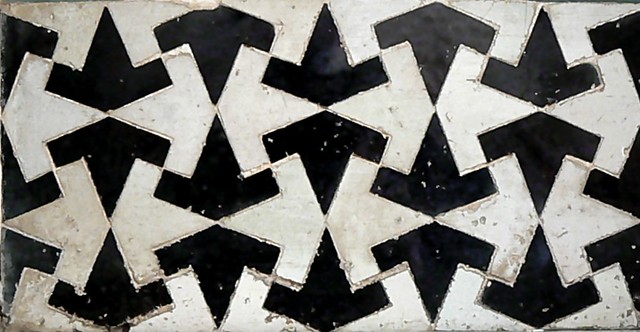
 Our study of motions led to one of my favorite topics in all of mathematics: tessellations. I've posted some previous work on this blog, have an old webpage with some good tessellation resources, and found a new source of beautiful Alhambra images to share with students.
 The question of which kites tessellate by double rotation boils down to what happens at the joint vertices between the two (possibly) different edges. We can pick the angles so that the kites blossom (tessellate around a point) at the vertices between congruent sides. In this sketch, you set those numbers, then observe the effect on the other angles. What condition is necessary for the angles to work out? Is it sufficient?


