MATHEMATICS

Tampilkan postingan dengan label inequality. Tampilkan semua postingan

Minggu, 30 September 2012

Greater Than

Previously: planning and coaching on inequalities.

The origin of this game was trying to think about a game that helped give students enough experience to intuit the rules for how operations with signed numbers affect inequalities. I think this is doubly hard for students because they don't have much intuition for signed numbers, and learn both integer operation and inequality rules by memorization rather than understanding.

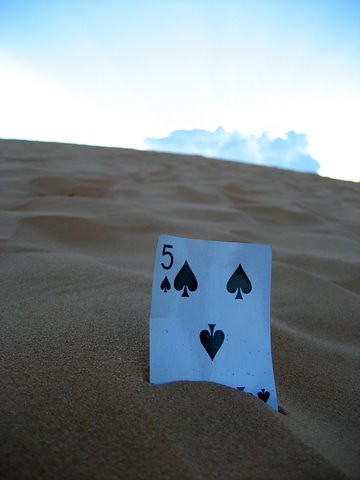
I love playing cards as a material for signed numbers because the red and black make such a nice positive and negative visual. (For more integer games, see this collection elsewhere on the blog.) I thought about students somehow constructing expressions, but I couldn't think of anything not clunky. I knew we wanted comparison, and I like War as a comparison structure. That made me think of the exciting moment of war, playing down extra cards on a tie.

When I played around with the cards, though, it didn't get at inequalities because each player was changing the value of only one side of the comparison. A big no-no in the context we want. So the played cards had to effect both players' values. It seemed confusing to have both players reveal at the same time, so I decided that - at least to start - players should take turns, even though that makes the optimal strategy pretty determinable. (If it's not a word it should be.)


After students get the strategy, go to the variation where both players flip at the same time or the dealer has one less card. If playing with middle schoolers for integer operations practice, try the flipping off the top variation.

I think this is a good educational game, but only close to a good strategy game. I can't quite figure out what's missing, so if you have a variation or adaptation to try, please let me know.

Evaluating this on my game design framework:
  1. Goal(s). Gain experience with effect of integer operations on inequalities. Works well. Also good for gaining experience with integer computation.
  2. Structure. The game generates a lot of these situations and the cards guarantee a mix of operations and values.
  3. Strategy. Pretty simple. On variation becomes a pretty nice bluffing game, but not intensely strategic.
  4. Interaction. What you do completely depends on opponent.
  5. Surprise. Hidden information and opponent plus randomization of cards helps here.
  6. Catch-Up. Victory is almost always possible.
  7. Inertia. Might be too simple for loads of play, but good enough for the objective.
  8. Rules. The idea of applying your card to both is non-intuitive, and remembering suits-operations connections is hard. You might want specialty cards
  9. Context. No context, but all the variations generated engagement from the preservice teachers.
One thing I want from this experience is a deck with operations for suits. Not sure if it should have all 4 operations, or multiplication and addition with positive and negative numbers or some other variation. What do you think?

Photo credit: Abulic Monkey @ Flickr

Selasa, 25 September 2012

Think Aloud: Planning Inequality

From the always fun Zappa Blamma
In my preassessment for preservice teacher (PST) high school mathematics course, I had a new topic grab their attention - inequalities.  In previous times teaching this course, that hasn't been an issue to which we've given much attention. My bad, as I've seen plenty of struggles with it in secondary classrooms. It's clearly an error where we retreat to instrumental understanding (using Skemp's terminology); rules, rules and more rules.

So what are the key ideas? It's an extension of the algebraic methods we're already using. So I want to focus more are the conceptual components of inequalities... which I haven't ever really deeply considered before.

The heart of inequalities is comparison, which is a key component of number sense. A key and often omitted component. Usually we introduce numbers (multi-digit, fractions, decimals, signed) and then are lucky if we even get representation work before we get to computation rules and rote. So that makes me think of a couple of my favorite games - Fraction Catch and Decimal Pickle. Probably not appropriate for a high school class, though I use them in the preservice middle school class to good effect. What would a high school version look like?

Hmm. It's the rules for changing the sign that get people all bothered. What if the players/teams started with a number, then multiplied or added to both players numbers... the goal could be to get the larger quantity in the end.  You could make special cards... or (I love being able to use regular dice, cards, dominoes, etc.) have the suits imply the operations. I'd have to think of how many turns, how many cards to have, some of the game mechanics. But that idea might be worth the work of developing something new.

Before being in math ed, I worked in index theory, that includes plenty of analysis. Analysis, as a mathematical field, involves a lot of estimates. Think nitty-gritty epsilon-delta proofs. This is less that that, which is less than or equal to the other, which means the whole thing is less than... I loved that stuff. So is there a way to get students making those kind of estimates?

That makes me think about experimental error. Error analysis is nice because of the connections to measurement. That gets us into volume formulas. Could even do a guess how many kind of competition. Hmm. I took a picture of a neat set up like that at the ND-U of M football game over the weekend, but it came out too blurry. And I don't know the result! (I guessed 1337. [LEET.] The bottom pyramid was 10 balls wide and about 20 balls tall.) Lots of good images for that on 101qs.com. Could use in class or make a good HW assignment out of that, and get the PSTs looking at that great resource. It would also let us talk a bit about measuring technique - important to get in somewhere. Volume ties into some of the higher degree polynomial stuff we've been doing...

I think that would make for good foundational experiences, and then we could do a follow up day to see how the ideas of inequalities we see apply in traditional algebra and algebra 2 problems.

Now to get working on that game...

ps. What I didn't do here that I usually do when planning, is look around what other people have about inequalities. That usually involves a visit to Sam's virtual cabinet, searching reader, raiding Kate's archive, etc. Where do you look for inspiration, adaptation and out and out robbery? (Accredited, of course.)

This story continues in the post on coaching. With video of an actual dialogue!