MATHEMATICS

Tampilkan postingan dengan label Fractions. Tampilkan semua postingan

Kamis, 19 September 2013

Fractions are numbers, too – Part 3

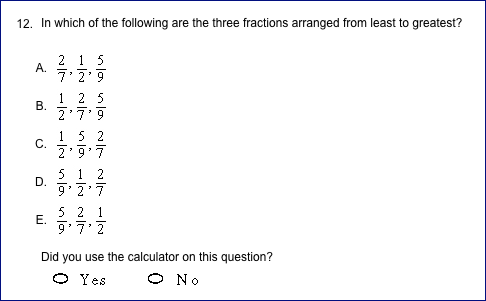
The National Assessment of Educational Progress (``The Nation’s Report Card’’) in 2007 posed the following question:


Sidestepping for now the issue that only half of eighth graders correctly solved an elementary school problem, calculator allowed, the intrigue lies in the distribution of wrong answers:

Read more »

Rabu, 26 Juni 2013

SBAC practice tests run-through – Part 1

At the end of May 2013, following its first pilot test for students, Smarter Balanced Assessment Consortium followed up on its previous releases of sample Common Core assessment questions with new batches for grades 3 through 8 and grade 11, in the form of online practice exams.

SBAC has since tweeted (read: crowed) unceasingly about these practice exams...
...and retweeted as well anyone else who’s mentioned the exams...
...in a positive light.

Read more »

Selasa, 23 April 2013

Find It!

Design
The call: a game for 5th graders just starting with fraction multiplication.

I look at my games. Fraction version of the Product Game... great fun, but more for practice than introduction. The crazy Ant Man game ... fun, good for calculator use, but also dividing fractions, so probably not time for that. Hmph.

Answer the question
(this was the first one)
Get it right to get a chance to
shoot past the goalie.
I look around on the web. Googled fraction multiplication game and got a lot of really awful drill "games." Glgkh - they left an awful taste. Some are obviously just quick flash mass production, but there are a couple that people really put time into looks and animation. For a quiz set to 8-bit music.


So, I'm on my own. Often with introduction time I try to think about representation. One of the things to love about fractions are all the many representations.  I think the discrete models are underused, so I thought about about students claiming fractions of a common pot (similar to the GeoGebra percent game I posted recently) - but it was difficult to figure out how to keep to intuitive numbers and overcome the disproportionate effect of going first. Also, I had trouble thinking of a game context that would get students to see it as a fraction of a fraction instead of a fraction of a whole number.

Then I thought about the area model. I imagined carving up a rectangle, having kids carve up rectangles. Scoring a total... connecting two points... then I had a connection. Cutting down bit by bit, it felt like searching for something. I tried a 12x12 grid, and my first pass at a mechanic worked pretty well: rolling a die to get halves, thirds, fourths. I thought of a context - searching for a lost hiker. Too scary if you've been lost? Finding a lost pet... maybe. It was a little too direct. Is it a competition? It was starting to feel like Battleship (a fine game), and that was good. I tried finding multiple objects; 2, 3, 4... and 4 was right. Oh! They could come up with the context - and that would give them the opportunity to add rules of their own. That's worth a try!

Here's the handout on Google docs: Find It!

Playing
I launched the game with my own context:
They managed to find all three, before... well before nothing. I was pleasantly surprised by how engaged they were just trying to find the rings. Like spontaneous applause when someone found one. (Playing with the whole class, I have them pass the die to someone who's ready of the other gender. Usually works.) Afterwards, I shared how maybe I needed more rules. Or the Mandarin's searching also. Or if you roll two 5's the Mandarin finds a ring. Or...

It was clear this was going to work because there was immediately a crowd of students trying to tell me their context, Minecraft, aliens, how it fit into the story she's writing about two wolves who turn into humans. It was exciting. They experimented with more than 3 objects and asked me why I had chosen three.


The wolfgirls.


Quite complex. This was played on two boards,
with interaction between the heroes and villains.


The minecraft game.
This had hazards as well as the goal.


The zombie game, which also had a hazard.
You had three lives, and had to find the zombie solution
before you lost all the people in your party.


The playing went well also. I was impressed by students ability to divide regions equally, and the many ways they found to do it. They started inventing their own terminology for how they were doing it, like the strips or plus method for dividing into four.  They used horizontal and vertical divides, and one group experimented with non rectangular regions. One group played like Battleship, competing to find all three before the other team did.

In feedback, everyone gave the game a thumbs up (mostly) or so-so. (Rare to have one that no one dislikes.) They liked the Battleship connection, the feeling of searching and the multiple objects to find. They were very excited to tell about their context and rules variations.


Game Evaluation
  1. Goal(s) - good - experience with representation, dividing up rectangular pieces into equal parts. Plus a context for future questions and rephrasing.
  2. Structure - works well.
  3. Strategy - puzzle like. Choice in which region to divide up with which fraction. Choices for where you hide the objects. Not the strongest element of the game, though.
  4. Interaction - good and so-so. One person/team being the mechanic for revealing spots and checking the other team's work on dividing was good mathematically. But Battleship isn't strong on player interaction.
  5. Surprise - die roll, so okay.
  6. Catch-Up ... depends on the variation. It's a bit methodical doing the search, but there's no time element in the basic version. The chance to get lucky with a search or a roll will help.
  7. Inertia - works for this. Students were anxious to play more.
  8. Rules - toughest element is the dividing up equally. Once you've got that idea, rest is simple.
  9. Context - here's the winner. Students being able to set their own context was very engaging for a vast majority.

Selasa, 16 April 2013

Percent Game Remixing

In yesterday's post on a percent game, I shared two great GeoGebra sketches that students found. I remixed each of them a little, so I thought I'd share them here.

dhabecker's neat rational number arranging sketch lets students place arrows to try to put fractions, decimals, and percents in order. He has a very clever way to check if the randomly generated numbers are in the right spots.  It notifies students when they've got all 4 right, and I wanted to them to be able to check their answer along the way. So - thinking of Mastermind - I thought about what if it can give the number correctly placed? Since I was doing that I added a reset button and a bit of color. Next I would add a fifth number, as that makes so many more permutations possible.


On GeoGebraTube:
download or applet. (Unfortunately doesn't seem to work in HTML5, because the polygons won't move.)


The other sketch I modified was David Cox's great percent estimation sketch.  Almost immediately on trying it on the Smartboard, the students turned it into a game.

So I turned it into a game with turns and scoring. There's 6 rounds. I thought about forcing players to take turns going first but ultimately just decided to ask them to.

Next  I would be interested in seeing it go from a percent number line to another quantity. So the game asks you to find 38%, but the number line goes from 0 to 630. The percent and the whole would change each time. Worth a go? Probably that's in my head because of David's nice double numberline percent sketch.

On GeoGebraTube:
download or mobile-ready applet.


As always, I'd be interested in feedback on either one of these.

But I'd also be interested in what could help develop a remix culture in GeoGebra.  I learned it (am learning it) mostly on my own by experimentation, from suggestions on Twitter, and googling stuff from the online help. But in the Learning Creative Learning class they put a big emphasis on remixing as a way to learn that gives a lot of support to learners. With my middle school GeoGebraists, they are struggling to do work of value all on their own.

Are you a remixer by nature? What would it take to get you trying it in GeoGebra?

Jumat, 22 Februari 2013

Fractions are numbers, too – Part 2

We have a lot to say about CCSSI’s treatment of fractions, which starts tentatively with 1.G.3, but we’ll initially hone in on Grade 3, which is where Common Core begins its big push.  We’ll discuss Common Core’s sequence, and compare or contrast it to our own preferences for how fraction concepts should be introduced, and if we differ, provide a (hopefully justified) rationale for our choices.

3.NF.1 states, ``Understand a fraction 1/b as the quantity formed by 1 part when a whole is partitioned into b equal parts; understand a fraction a/b as the quantity formed by a parts of size 1/b.’’

Read more »

Selasa, 12 Februari 2013

Fractions are numbers, too – Part 1

We hold these truths to be self-evident, that all numbers are created equal...
(Well, Abraham Lincoln or Thomas Jefferson could have written this.) 
On February 8&9, 2013, while much of the northeastern US was getting socked with a blizzard, a symposium was held at Educational Testing Service headquarters in Princeton.  The meeting between ETS and the National Urban League was entitled "Taking Action: Navigating the Common Core State Standards and Assessments," and the purpose was to ``discuss [the] impact of Common Core State Standards on underserved communities’’ and ``consider strategies to succeed with the new standards and assessments.’’

We stumbled across the live-twitter feed by accident, but immediately recognized the meeting's significance, as David Coleman, Joe Willhoft, and Doug Sovde, three Common Core ``biggies’’ were all featured speakers.  For them, it offered an opportunity to ``sell’’ CCSSI to important community groups: in addition to the NUL, representatives of the NAACP, NCLR and SEARAC were also in attendance.

Read more »

Senin, 04 Februari 2013

Spirograph 2 - GeoGebra Animation

Okay, I've played with cycloids before. But when Guillermo recently updated his hypocycloid tutorial, it gave me the push to play again, since I'm always trying to get better at the GGB. Making it helped me understand GeoGebra animation a bit better, so I thought I'd share. I also think the resulting sketch could be the basis of a pretty nice open ended activity.


Obviously, having too much fun.

As good as Guillermo's instructions are, I'm the student who wants to figure it out for himself. One of my easiest teaching mistakes is to assume that my students are like me, and to provide too little support. Although I can overcompensate and then dictate too much, too. To provide student choice is the ticket.

So I started with the circle. I debated about making the controls be the radii for the boundary circle and the rolling circle, but finally decided to make it the boundary radius and a fraction of that for the rolling circle. Originally just a decimal, 0 to 1 incrementing by .05, but eventually I decided to make it a proper fraction, and on the slider control made the increment 1/60. It will show as a decimal approximation, but GGB stores it as the fraction for all practical purposes.

Then the rolling. The usual thing to do animation is to make a slider for time. My first take was to have the slider just go from 0 to 2\(\pi \). (Or 0 to 360 degrees, but I didn't want the units hassle.) Then I increased it to 10\(\pi \), but finally decided that it's neat to choose the number of rotations, so I made a 'circuits' slider for how many revolutions and defined the time slider to go to circuits*2\(\pi \). I use sliders instead of input boxes when possible because the input boxes don't work in HTML5/mobile devices yet.

Now the geometry. Really the rolling circle slides around the boundary at a contact point, rotated by the time slider away from some arbitrary starting point. The rolling you simulate by rotating the sliding contact point around the small circle. But how far does it rotate? My naive first take was that it should be as far as you've slid around the larger circle, thinking about it as a distance, like a string wrapping around. When you've gone angle \(\alpha\) around, you've gone distance \(\alpha\)*radius. Putting that in...
... pretty! But not a trochoid. It took me a few minutes to realize that I wanted the angle to rotate, not the distance. So if the circumference you've traveled is \(\alpha\)*big radius, then that's
$$
\frac{\alpha * \text{big radius}}{ \text{small circumference} }
= \frac{\alpha *a}{2\pi*\text {small radius}}
= \frac{\alpha *a}{2\pi*b*a}= \frac{\alpha}{2\pi*b}$$
So the angle is \(\frac{\alpha}{2\pi*b}*2\pi\) or just my time&angle variable divided by my radius ratio, t/b. I still have to think about what happened with the first try - obviously there's something mathy there.

It didn't look a lot like it was rolling, so I added the spokes to the small wheel by rotating a segment from the center to the rolling point around the small circle center.

Since I added the number of circuits as a variable, it made the speed of the sketch animation change and I couldn't find a value that was good for any number of circuits. But when I added a slider for the speed of the animation, I lost the play/pause button for the time. You can still control it with a right-click context menu, but that's not very user friendly.

So I started digging around the GeoGebra manual for animation controls, and finally found StartAnimation.  In particular, the boolean version,
StartAnimation[ point, slider, ... , boolean]
animates whatever is listed if the boolean is true, and stops it if false. Now I could make a boolean variable for animation (called 'animated' here), and control it with a button.

I'm using SetValue more than variable assignment lately because it avoids some weird issues that come from fixing a variable. ("!" is the text version of \(\not\) ) This also allows me to make the animation of t just a once through instead of repeating, which makes choosing the number of circuits more relevant. Here's the final version of the time slider:

To make the sketch more Spirography, I  took out some of the erasing and timer resetting from the scripts for sliders and buttons, and added in the color controls for the pen. The color values in GeoGebra are between 0 and 1, as opposed to 0 to 255 in some programming.


Activities/Problem ideas:
  • Given a ratio, how many circuits to completely draw the hypotrochoid? How many vertices will it have?
  • How are the hypotrochoids for ratios with common denominators similar and different? Why does that happen?
  • Make an image that is aesthetically appealing to you. Document your process. What did you have to figure out to make it? What math can you see in the final image?
  • What kind of mathematical curve is one side of a hypotrochoid? How do you know? Can you prove it? Why would it be that way?
  • Give students a challenge image, and ask them to duplicate it or investigate the mathematical properties. Or ask them to make a challenge image for another group then swap.
How else might you use a sketch like this?

Here's the sketch at GeoGebraTube or as an applet (works on mobiles).  Hope you have at least 11/60 as much fun as I did with this.

Post Script:
With that work done, it's been easy to add features. I added a mirror point on an outside circle so that the sketch could do epicycloids. Then I dilated the pen points from the center of the rolling circles to get full on trochoid glory. Here's the final sketch on GGBT and mobile app.

Have fun! Send me a cool image!

Minggu, 20 Januari 2013

Too Puzzling

The content objective: adding and subtracting fractions with unlike denominators, for 5th grade students.

What game? On short notice... I have a couple race games and Mr. Schiller has pattern blocks - but those use the fraction cards which I like, but were also at my office.I was thinking about a game where students start at one, and one team tries to race to 2, while the other team takes away and races to zero.  That would be good for building intuition, and learning to record fraction number sentences, but this is their last day with fraction operations before moving on to something else. What could serve as a review?

I thought about a game you could play with a small number of cards (one sheet), or a game where they would be doing review problems and checking each other as they play. Somehow I was reminded of a tarsia puzzle. (Here's a bunch at tes, among other places. Not sure who tes is, really.) Mostly those are triangular, but I decided on a square pattern, more familiar to the students. Here's what I wound up with. Made the grid in GeoGebra, of course.


A lot of thought went into the puzzle. I repeated a couple values to make it so that a match did not conclusively mean that two pieces went together (harder). I made all of them doable with 24ths (easier).  I decided on a 3x3 vs a 4x4 (easier). I made almost patterns on borders (harder and easier). Made sure some of those were nonmatches (easier). Related problems, like 1/4+1/2 and 3/4-1/2 (easier). Some operations where the common denominator is one of the present denominators, 2/3-1/6. And one mistake. (Crazy harder. Fixed version above.) I tried to put in some common characteristics on adjacent tiles. (Hmmm?) If they've been doing these problems in general, I thought that this would be enough support for everybody, especially working in teams.

To differentiate, then, I was mostly thinking upward. On the original puzzle they could make 3 more squares to make it a 12 piece puzzle. I made one with some triangles blank for the students to work out sums, differences or make up a problem, and then an entirely blank one for them to make up their own Tarsia.

I launched the puzle by showing cut out pieces, telling them it was a puzzle and asking how it might go together. Through whole group discussion they figured out that the sums and differences matched some of the fractions. I compared it to the puzzles that are all squares that divide up pictures, which are pretty tough. After finding a few of the matches together, they formed pairs and came up to pick up their choice of puzzle. Only one group took an option on the partially filled in puzzle.

They did not like it. Found it too hard, or didn't know how to start. Mr. Schiller and I circulated and helped people get started. They found lots of matches, but before our time was up were moving on to other pursuits. Not interested in making their own.

To wrap up, we came back together and did some together to get a firmer idea of how to do it. They confirmed that it was beyond them. When I asked for words of wisdom, one student volunteered: "You might want to try it yourself, first. If it's too easy, add stuff to make it tougher. If it's too hard, make it easier."

Wise words, indeed.

To use this in fifth grade again, I think I might concentrate on first getting a square of four made, and then try to grow it. Mr. Schiller recommended either a fraction equivalence puzzle or a fraction-decimal equivalence puzzle to get it launched. I still love these kinds of puzzles, but fee like I learned something about introducing and using them with younger learners.

Post Script:
Jeff says: The equivalent fraction version of that worked a lot better.  I sort of sneakily encouraged them to also incorporate equivalent decimals too.  In the version we played in the afternoon,  they created their game board in pairs and then they matched up with another team and exchanged puzzles and it became a race to finish the puzzle first.  I sort of mentioned in an offhanded way - oh yeah, and if you wanted to make it a little more challenging for your opponent, you might include some equivalent decimals, too.  (That did the trick)


Jumat, 08 Juni 2012

Size the Day

It was time for my last game with the fifth graders, and the content was multiplication and division of fractions.  Having just been critical of a game that was very computation focused (see my Math Evolve review) I was very wary of doing the same thing.

I'm at the point now where I've designed more games than I can remember easily, so one of my first steps in game design is to search my own stuff. Failing finding a game to use, maybe there's one to revise. Failing that, maybe one to revise. I did stumble across my post on multiplying fractions. Oh.

I have many lessons that get at the meaning of the operations, can be used to start discovering, exploring and justifying the rules... but only the Product Game (adapted for fractions) for practice. But that post closes with an Ant Man and Wasp cartoon, and we'd been talking a lot about them because of the Avengers movie.  My son is a comic book fan (sounds better than monomaniacally obsessed, right?) so this was quite a debate. He loved the movie maximally, but would have loved it even more with the original comic book Avengers crew. (Joss Whedon wanted characters to whom non-super powered audiences could relate as well as the super powerful ones.)

By Xavier Golden, Super Hero Squad style.
"The hexagons are Pym Particles."

So I was struck with the idea of a size-changing game. But why would our heroes have to constantly change size?  To get past obstacles! Sometimes they'd have to grow, sometimes to shrink. I tried to think of a battle game because there were several boys always interested in that, but for battle it seemed like you'd almost always want to be giant-sized instead of ant-sized. So a kind of maze... so it could be a race game.

I tried to think of a way to turn dice rolling into fractions for multiplying or dividing, or to roll three and choose two, but that didn't feel appropriate for such new content. I wanted actual fractions to see and think about. 


If you have transparent spinners, this is a good place to use them; I just used bobby pins, which make excellent spinner needles.  I experimented with the spinner entries and maze heights to find settings that were not too immediate but not too difficult either. Thinking about the framework I've been using...
  1. Goal(s) - solid. I wanted students to get the understanding of the effect of multiplying and dividing by fractions, so contrary to their expectations. I wanted to get some sense of estimation, and some experience with calculations that would lead to support the symbolic rule they'll learn later. I'd also noticed that they were very interested in calculators, but had little experience with using them. This put everyone on an equal footing, as the numbers were messy and required a calculator.
  2. Structure - like the stretching/shrinking as a context for multiplication/division. The spinners allowed a lot of flexibility in getting values to be used. Makes the game highly adaptable. And the intention of having to choose a multiplying or dividing spinner helped get across the stretching or shrinking effect.
  3. Strategy - weak as it was.
  4. Interaction - typically weak in race games, though .
  5. Surprise - spinners help here and with...
  6. Catch-Up .
  7. Inertia - not meant to be a game that requires a lot of replay.
  8. Rules - basic premise, spin and change your height. Move forward when you fit.
  9. Context - thought this was strong, plus pop culture tie ins to a heavily advertised movie. Kids were interested and engaged, though I sold it a bit explaining about Ant Man and the Avengers. There's a little suspension of disbelief, as Wasp could just shrink and fly through all the obstacles, and it's rare that she grows in the book.

I added the Spin Again option to help with catch-up, strategy and interaction. But most students were so immersed in their own spins that they rarely used them! The other idea that I like quite a bit was the customizable board. Most of the fifth graders were happy to use the board as printed, but a few experimented with rearranging the board.  Maybe with middle school students, more would be interested in giving it a go. Designing a board for your opponents is a great opportunity for some open-ended problem solving.  I picked up a couple packs of mini post-its, and they were perfect for keeping track of the players' heights.

It was a good last game of the year. In the debrief, they definitely got the point that multiplying and dividing by fractions did not just have the same effect as multiplying by whole numbers, and a few kids were noticing that dividing by unit fractions was like multiplying by the denominator. I also saw considerably increased skill with the calculators, and some sensible rounding of the decimals involved.  (Parentheses were almost entirely new to them.) They asked me to leave the supplies so they could play later, and it got almost 100% thumbs up for keep or dump - both good signs.

Hopefully you can get a chance to give this one a try. It has some interesting features, and I think the choice of spinners and rearrangeable board will show up again - good game mechanic features. I'm always interested in your feedback, if you have any ideas or get a chance to use it with students. One dramatic need: the name is a terrible joke, and of absolutely no use with middle school.  Ideas?

Senin, 27 Februari 2012

Some Sum to One

Another quick activity. Put this version of it together for the 5th graders, but didn't get a chance to do it with them. This would be suitable 5-8, and my preservice teachers got a lot out of it also. I added some more support (in structure) on the square for middle school age kids. The grid divides well into thirds, fourths, twelfths and the like.

The idea was probably Mondrian inspired, mixed with a geometry activity that I like: divide a geoboard into four non-congruent equal parts.

The task for this one is to make different fractions that add, or fit together, to one, or a whole square. Had very interesting conversation with Dave Coffey today about fractions and introducing operations, and representation... and then that conversation spread to Lisa Kasmer.  Nice to work with such interesting colleagues.

EDIT: oops! had the permission set incorrectly on this. If it's not appearing below, here's the link to the pdf.


Two examples from my preservice teachers. The second one was made with flaps that lifted up to reveal the value of the fraction shown. Nice!


You can have your students simplify or not - both create interesting situations.

A nice extension challenge is to do this Egyptian style, with all unit fractions.

Sabtu, 28 Januari 2012

Fraction Catch

Sometimes it surprises me what I haven't written about here. Fraction Catch is one of my favorite games and it's been pretty successful in implementation from third grade to ninth grade. Partly the game, and partly the fraction cards.


I'm quite happy with the rectangle representation for the cards, as I have seen younger students use it a lot to do reasoning, and get a better sense of what the fraction is.

I often think of number sense having several parts:
  • understanding the number as a quantity
  • being able to flexibly represent the number
  • being able to compare two or more numbers
  • being able to compose and decompose the number flexibly
Whether the numbers in question are whole, integral, rational, real, radical, complex, or matrix. (Matrical?) The last bullet is, of course, the key to powerful computational fluency. Often I see students who have too little experience with the number as an actual quantity as opposed to a symbol, and it's positively frequent that students have no or limited ability to represent numbers other than symbolically.

It's very possible that the last two bullets are not actually part of understanding the number, so much as they are activities that deepen the first two characteristics, but I don't see the point in distinguishing them.

The game is very simple. Each player has a hand of three cards, plays a fraction onto the line of cards arranged least to greatest, and captures the lower adjacent card if they were able to play in between. Here's the rules and an example:


Playing this week with Mr. Schiller's class, I thought maybe this would be a chance to focus on the rules aspect of a game.  I asked what might make the rules for a game good, or understandable, and they had no idea. It took a bit of rephrasing just to get across my question.  I got the sense that I was not starting at the beginning, and switched tacks. Instead of demonstrating it first, I asked them to read the rules and then tell Mr. Schiller and I how to play.

It was challenging. Not very engaging, switch from the normal routine, and really communicated to me that I have to or maybe just should do some equipping to get them to be independent game players before working on teaching them designing. The class leaders got the idea, and taught the game to us and the rest of class. Mr. Schiller trounced me which they very much enjoyed. It was the terrible draws, I'm telling you.

Actually playing the game, though, students played pretty intently, though playing a couple games was enough for some. One interesting thing was what they went on to play. We suggested war or high-low-war for some, but one group used the cards to play their own version of Flower Power, a rational number ordering game from MangaHigh. (A lot of my favorite free computer math games are there; teachers register students and can track their progress.) Another group just wanted to put all the cards in order to make as long a streak as possible.  Then they were noticing patterns about which cards were in the set and which weren't.

After the game, there was one good suggestion for a new rule: if you have two no-play turns in a row, you can swap in your whole hand for a new one.

Students made lots of good connections with the representations, and used them to compare fractions. Not too many got to the point where they were developing a strategy on where to play, but far enough that they would choose scoring plays over easy plays.

To summarize I put up some of the comparisons I had seen. All the students did well on comparing like denominators, like 3/8 and 5/8. They also were mostly solid on comparing like numerators, like 2/5 and 2/3. We talked for a bit about 2/3 and 3/4, and they used the nice strategy of how far from a unit they were, but the class couldn't figure out together how 7/10 compared to those two.  Mr. Schiller let them know they'd keep the cards so they could play again later. He was impressed how well they played even though they had covered little of this in class beforehand.

Game Evaluation:

  1. Goal(s) -spot on. Really addresses important ideas.
  2. Structure - representation, ordering for the comparison, and some strategic depth that requires the numeric understanding.
  3. Strategy - present.
  4. Interaction - high in interaction, as what you are able to play and what you choose to play are both influenced by the opponent.
  5. Surprise - the card game aspect helps with this and with catch up.
  6. Catch-Up - check.
  7. Inertia - the game ends quickly enough that most students want to continue playing. Because strategy deepens and fact knowledge increases with more play, it has pretty good replay value.
  8. Rules - seem clear enough for the students to make sense of, but it was better modeled than read.
  9. Context: Fun-Flavor-Hook. No context, not sure if it would help. More professional cards would be something; I had some paper decks and some cardstock, and the students preferred the cardstock. Talking about the rectangles as brownie pans was interesting to them... so maybe you could contextualize it. I think it's better as playing cards.
Strong in the yellow, green and blue makes this a good learning game. Give it a go and let me know what you think!


Jumat, 30 September 2011

Fraction Sense

Watched a nice video about Dor Abrahamson talking about how math is, or should be, about making sense.


In this video he describes a device to let students play with a proportion, and I thought it would be simple enough to do in GeoGebra, so... here you go! I'm pretty happy with the sketch, it's clean and the controls should be simple enough for young students.  Close means within 5%, and Wow! is within 1%, so it's easier with a large unit. There's a lot of research supporting introducing fractions with a comparison model before the typical part-whole model, so it's nice to have a tool for that.
Available as a GeoGebra file or dynamic webpage. I've mostly stopped embedding GeoGebra files on the blog because it adds to load time significantly, it seems faster as a separate webpage.What other fraction representations would you like to see in a dynamic representation?

EDIT:
Made this before GeoGebraTube! I've updated this a little with a practice mode and more sensible checking. Here's the Teacher page (download) or the Student page (applet). Also have made this multiple choice fraction estimation applet.

Kamis, 03 Maret 2011

Battle of the Century

Dorky little skit I wrote a while ago. Should we film it?


Fractions vs. Decimals
The Battle of the Century

Ringside Announcer (RA): Welcome ladies and gentlemen to the Battle of the Century: Fractions vs. Decimals!

Old Man Fractions has been king of the hill for so long he can remember the pharaohs. But relative new-comer decimals has been rocketing through the ranks past previous contenders like Mixed Numbers and Percents, buoyed by the rise of science and handheld technology. Tonight they settle the issue once and for all, mano a mano.

Color Commentator (CC): That’s right, Jim. And they have both clearly prepared. Fractions has developed his upper body so much he looks positively improper. Decimals has emphasized speed work, and is awfully quick to the point. Hey, looks like they’re ready to start.

RA: They come out swinging! Fractions looks like his strategy is to corner decimals and work his weaker visual representations. Oh there’s a pie model and a fraction strip combo! Decimals finally lands a 100 grid haymaker and gets back out to the center of the ring.

CC: Looks like that speed work is paying off, Jim. Decimals is coldly calculating without having to hit any special menu buttons on the calc, if you know what I mean.

RA: Not really, Howard, but I’m used to it. Oh! Decimal made a rounding error and Fractions lands an uppercut.

CC: That’s exactly the answer, Kid Decimals!

RA: The traditionalists are out of their seats, cheering on Fractions. Even the French are into it!

CC: He’s certainly got that je ne sais quoi, eh, Jim?

RA: Huh? Back to the action, Fractions is pressing his advantage. But decimals sees an opportunity and – oh! The referee calls time!

CC: I don’t think it was intentional, but that was definitely below the vinculum.

RA: The referee gives Decimals a warning and they’re back in. Fractions still looks a little wobbly, and Decimals presses the advantage, really working over Fraction’s arcane and misunderstood algorithms.

CC: Invert and multiply that! Whew!

RA: Fractions gives a nice example of unit fraction multiplication and is back in the fight. Oh, and lands a nice left hand on a complicated long-division problem.

CC: Decimals looks like he doesn’t know if his point is going left or right, Jim.

RA: It’s back and forth at this point folks. Fractions simplifies nicely, and catches Decimals a good one. Decimals lands a nice easy comparison, but Fractions hits a unit confusion counter-punch.

CC: That’s half of something, alright.

RA: Then Decimals comes right back with a repeating combination! Oh, and a non-terminating, non-repeating wallop! Fractions has no answer for that.

CC: Right in the Pi hole! Practically transcendental ring work, Jim.

RA: They’re really taking a beating out there. Howard, I think the crowd’s getting confused about what’s important here.

CC: I think you’re right, Jim, there’s kind of a baffled silence. Not that unusual at a rational battle like this one, though!

RA: That’s time. The fighters move to their corners. The judges communicate their decision to the ref. It’s pretty close on my scorecard, Howard. What do you think?

CC: Did you double check your answer, Jim? Nothing would surprise me –

RA: The ref is ready and brings both fighters to the center of the ring.… he pulls up both fighter’s hands! It’s a draw!

CC: The judges have called them equivalent! Oh, man! Looks like we’re in for a rematch.

Photo credit: tanita1 @ Flickr
Selasa, 10 Agustus 2010

Fraction Multiplication

Meant to have this done for the most recent Math and Multimedia Carnival, but I just couldn't finish it.  (Obviously still worth checking out the carnival, though.)

One of my goals for this week was to get fluent at embedding Geogebra in the blog.  Kate Nowak already laid out the directions, so it should be easy peasy.

Fraction Multiplication - Area Model
In this picture, the grey rectangle represents one unit of area. Two fractions can be shown relative to that rectangle, as well as their product.

Can you see how the sketch shows the red fraction? The blue fraction?

If you uncheck show product, can you predict what it will be?

Can you see why the unsimplified product is what it is?

Does the simplified product make sense compared to the grey rectangle being equal to 1?


Sorry, the GeoGebra Applet could not be started. Please make sure that Java 1.4.2 (or later) is installed and active in your browser (Click here to install Java now)


Created with GeoGebra

Also available as a standalone webpage or the original file.  My only difficulty embedding was getting the first line of the applet correct.  It needs to be as below,  where the height and width are what's appropriate for sketch.  (The archive value was without the web address in my html export from Geogebra.)

applet archive="http://www.geogebra.org/webstart/geogebra.jar" code="geogebra.GeoGebraApplet" codebase="./" height="560" name="ggbApplet" width="639"

As for the Geogebra, here's what I did.  Construct a rectangle, and measure the dimensions.  Set up sliders for numerators and denominators, by limiting the range and setting step size to 1.  Debated about allowing improper or not.  When I decided to allow it, made the numerator sliders proportional, so the visual would support the comparison.  I made the fraction rectangles by using the slider fraction to establish a proportion of the unit dimensions.  So if the unit width was 9 units and the fraction was 2/3, made a circle with radius (2/3)*9. (literally (e/f)*distanceAC) The partition lines were made similarly, by making a unit distance and then translating the lines.  The trickiest bit was the conditional visibility of the partitions.  I set them to be visible if the the numerator was large enough.  (I.e. the 12th line is only visible if the numerator is >= 12.)  Then when I made the show/hide buttons, I lost all that.  Sigh.  I went back in and used the boolean variable and AND (^ from the menu, not the up carat which is for exponents), like w ^ j>=12. 

I haven't ever had critical feedback on my sketches, so if you feel inclined, please let me know.  (Well, students let you know, but I mean collegial feedback.)

OK, here's my Camtasia student film.  I'm definitely interested in screencasts, but am not sure as to what features make them effective (or annoying), and how to use them effectively.  This must be the most boring one, ever.

Fraction Multiplication

Meant to have this done for the most recent Math and Multimedia Carnival, but I just couldn't finish it.  (Obviously still worth checking out the carnival, though.)

One of my goals for this week was to get fluent at embedding Geogebra in the blog.  Kate Nowak already laid out the directions, so it should be easy peasy.

Fraction Multiplication - Area Model
In this picture, the grey rectangle represents one unit of area. Two fractions can be shown relative to that rectangle, as well as their product.

Can you see how the sketch shows the red fraction? The blue fraction?

If you uncheck show product, can you predict what it will be?

Can you see why the unsimplified product is what it is?

Does the simplified product make sense compared to the grey rectangle being equal to 1?


Sorry, the GeoGebra Applet could not be started. Please make sure that Java 1.4.2 (or later) is installed and active in your browser (Click here to install Java now)


Created with GeoGebra

Also available as a standalone webpage or the original file.  My only difficulty embedding was getting the first line of the applet correct.  It needs to be as below,  where the height and width are what's appropriate for sketch.  (The archive value was without the web address in my html export from Geogebra.)

applet archive="http://www.geogebra.org/webstart/geogebra.jar" code="geogebra.GeoGebraApplet" codebase="./" height="560" name="ggbApplet" width="639"

As for the Geogebra, here's what I did.  Construct a rectangle, and measure the dimensions.  Set up sliders for numerators and denominators, by limiting the range and setting step size to 1.  Debated about allowing improper or not.  When I decided to allow it, made the numerator sliders proportional, so the visual would support the comparison.  I made the fraction rectangles by using the slider fraction to establish a proportion of the unit dimensions.  So if the unit width was 9 units and the fraction was 2/3, made a circle with radius (2/3)*9. (literally (e/f)*distanceAC) The partition lines were made similarly, by making a unit distance and then translating the lines.  The trickiest bit was the conditional visibility of the partitions.  I set them to be visible if the the numerator was large enough.  (I.e. the 12th line is only visible if the numerator is >= 12.)  Then when I made the show/hide buttons, I lost all that.  Sigh.  I went back in and used the boolean variable and AND (^ from the menu, not the up carat which is for exponents), like w ^ j>=12. 

I haven't ever had critical feedback on my sketches, so if you feel inclined, please let me know.  (Well, students let you know, but I mean collegial feedback.)

OK, here's my Camtasia student film.  I'm definitely interested in screencasts, but am not sure as to what features make them effective (or annoying), and how to use them effectively.  This must be the most boring one, ever.

Kamis, 13 Mei 2010

Multiplying Fractions, Times Three

In a gig with Mr. Schiller's 5th grade last week, I was overcome with indecision.  They'd been working on fraction multiplication and I had three related activities, and asked the teacher to pick based on what he wanted for the class.
The first was just skill practice.  (This is the option Mr. Schiller chose.)   I had never made it, but was confident that you could make a good fraction version of the Product Game.  This is almost what I made:
The only change is that I originally left off 5/12, but the fifth graders convinced me that it should be on.  My thinking was that it would be nice if one unsimplified product was not available, creating a situation where players had to consider equivalent fractions.  But the game itself brought it up enough that I think it's unnecessary.  Click on the image for the full size image which should print properly.

These students have been practicing fraction multiplication, and simplifying and 'unsimplifying' the result.  They have played the Product Game, which is the greatest math practice game ever.  (In the Connected Mathematics Project Prime Time module now, may be from the Middle Grades Mathematics Project before that.)

I launched the game by playing me vs. the class.  Reemphasizing that you only get to change one factor at a time, the goal is to get four in a row, and the new idea that there are equivalent fractions.  If you multiply and get 6/12, you can cover 1/2, and vice versa.  Then the students played pair vs. pair.  At the end we summarized by discussing what they noticed about the game, and what they thought made for a good strategy.  I did point out to them that someone would tell them fraction division was hard, but they've already done it when they're figuring what to multiply 3/4 by to get 6/12.

The second idea was to have the students develop the ability to make sense of their answers through a constructive representation.  Right now, I think the students are mechanically carrying out the multiplication, without much intuition to inform them if their answers are sensible.  These questions are adapted from an activity I do with my preservice elementary teachers.


I like playing the video before the activity, but that is obviously optional.


Potatoes
"Potatoes, mash em, boil em, stick em in a stew.” – Samwise Gamgee.

Things are _______ (awful, bad, okay, good, great) because you have potatoes!  Draw a picture to justify each answer.  Write an equation or number sentence for each story, if you can.

Find how many pounds of potatoes you’ve got if you search the cupboards and find…
1)  1/2 a bag of potatoes, which started with 2 pounds of potatoes.

2)  1/2 a bag of potatoes, which started with 2/3 pound of potatoes. 

3)  3/4 a bag of potatoes, which started with 2/3 pound of potatoes. 

4)  1 ½ bags of potatoes, which each started with 2/3 pound of potatoes.

5)  1 ½ bags of potatoes, which each started with 3/4 pound of potatoes.

6)  4 bags of potatoes, which each started with 1 1/3 pound of potatoes.

7)  2 2/3  bags of potatoes, which each started with 3 ¼ pound of potatoes.

8)  ____ bags of potatoes, which each started with ____ pounds of potatoes.
(You make the problem!)


The numbers are chosen pretty intentionally to allow for some connections and the possibility of relating the quantities to each other.  I like potatoes (of course) because they can be used for a discrete or an area model or a nice casserole.  My plan was to start with problem 2, demonstrating for the class a couple different models, and then have them start on number 1.

The third option was to get at a new context for multiplication.  As anyone following the Keith Devlin multiplication fiasco knows, the prevalent contexts for multiplication involve repeated groups.  One of the other contexts that is often nice for rational numbers is the idea of stretching and shrinking.  That always puts me in mind of Alice, and how her terrific adventures began.

 Go Ask Alice
“One pill makes you larger, And one pill makes you small
And the ones that mother gives you, Don't do anything at all
Go ask Alice, When she's ten feet tall” – Jefferson Airplane

Sort of from “Using Alice in Wonderland to teach Multiplication of Fractions,” Susan Taber, MTMS, Dec 2006

“There seemed to be no use in waiting by the little door, so she went back to the table, half hoping she might find another key on it, or at time she found a little bottle on it, ('which certainly was not here before,' said Alice,) and round the neck of the bottle was a paper label, with the words 'DRINK ME' beautifully printed on it in large letters.”  Alice in Wonderland, Lewis Carroll.

It turns out that she drinks it, and shrinks to 1/6th her former size.  Now she later finds a cake…
“She ate a little bit, and said anxiously to herself, 'Which way? Which way?', holding her hand on the top of her head to feel which way it was growing, and she was quite surprised to find that she remained the same size: to be sure, this generally happens when one eats cake, but Alice had got so much into the way of expecting nothing but out-of-the-way things to happen, that it seemed quite dull and stupid for life to go on in the common way.”  But soon, “Just then her head struck against the roof of the hall: in fact she was now more than nine feet high, and she at once took up the little golden key and hurried off to the garden door.”

It made her grow almost 12 times larger.

1)    What height would she be if at 10 ft tall she took a sip of on-sixth potion?


2)    If she started at 5 ft tall, and then took a sip of one-sixth potion, how tall would she be?  In feet?  In inches?


3)    If she took a bite of ten times cake and then a sip of potion, would she be the same height as what she did, which was take a sip and then take a bite?


4)    Having had one sip and then one bite, how close can she get back to her original size?


Let’s add to the story shall we?  Suppose she finds a times-three cookie, and a one-fourth soda.
5)    Starting at 5 feet, what height does the one-fourth soda make her?


6)    What effect would the times three cookie have, followed by the one sixth potion?


7)    If she starts at 5 feet and wants to be 6 feet tall at the end of it, what should she eat?


8)    In the story she wishes to pass through a 15” door.  If she had the choice of all four magic items, what should she do, starting off at 5 feet tall?


9)    What other mixtures are possible with all four items?


What does this have to do with fraction multiplying? 

What did you learn from these problems?


It's just such an amazing context, and that's without getting into the mushroom, which she uses for more controlled growing and shrinking later on.  Of course when my son is ready for these problems (soon, I think) we'll have to switch the context.

He shrinks, too.  Perfect!